

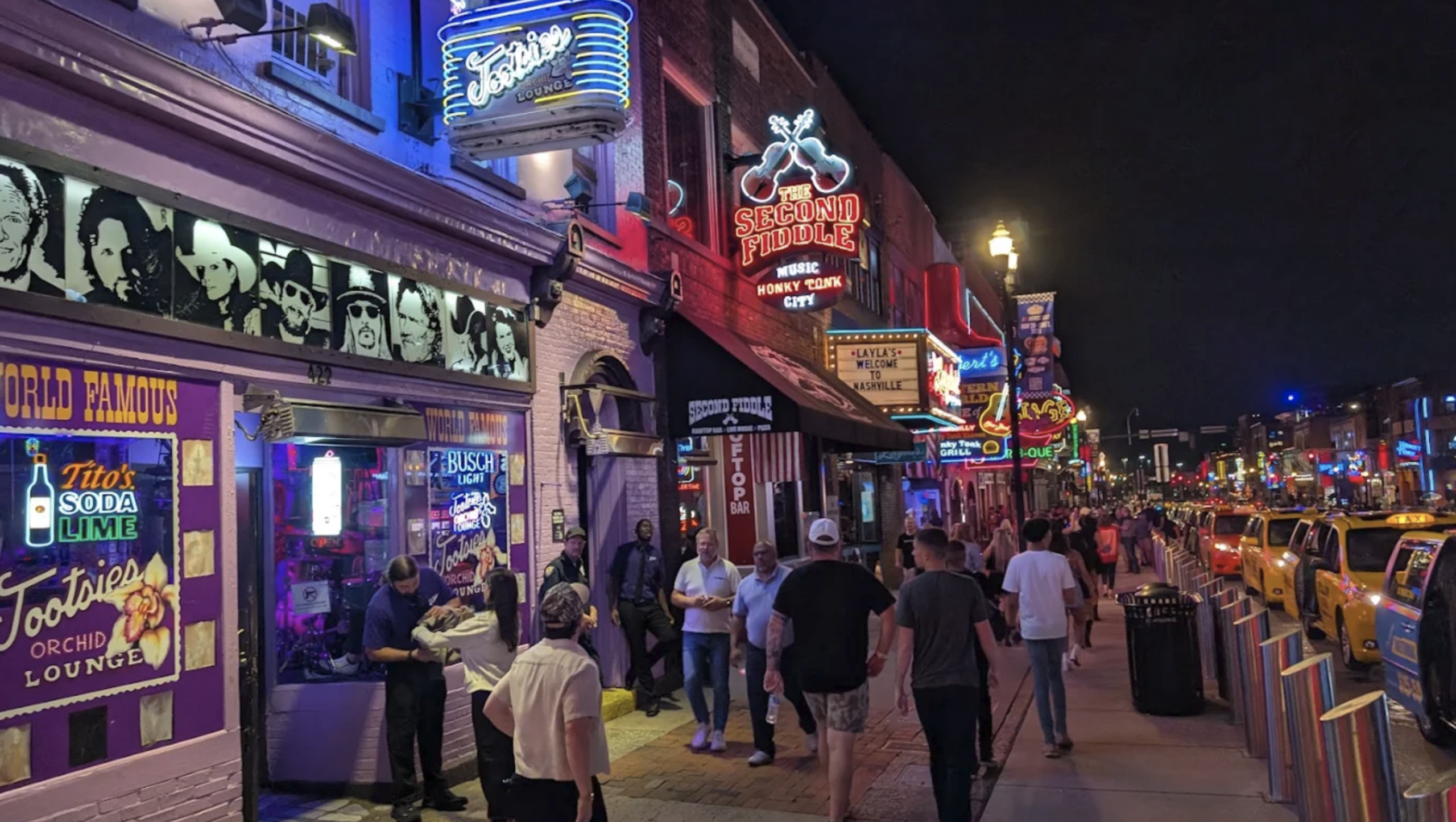
On New Year’s Eve, Second Fiddle at 420 Broadway poured its last round. By New Year’s Day the doors were shut and the staff was online asking around for work.
Second Fiddle was one of the family joints that made living in Nashville worth while back in the day. Ruble and Brenda Sanderson owned it, along with Legend’s Corner and The Stage. A few doors down, the six-story celebrity bars kept the neon on and the bachelorette parties rolling.
If you want to know where Nashville is headed, start right there on lower Broad and look at whose name is on the building.
The tax man and the triple net
Carey Bringle sells barbecue in the Gulch. Back in 2013, the property taxes on his building at Peg Leg Porker ran about $9,700 a year. Last year the bill was about $86,000, according to Fox 17. That’s roughly an 800 percent jump, and he didn’t add a single square foot or a second smoker to earn it.
Bringle has been telling you about this for years, and nobody can say he didn’t warn us. Back in 2020, when Mayor John Cooper pushed a 32 percent property tax increase, Bringle wrote an open letter to City Hall that boiled down to “enough is enough.” He figured the hike would take his bill to $72,000 a year. That’s $6,000 a month before he buys a single bag of charcoal.
He was wrong. It got worse.
“We had a 32 percent tax increase under Mayor Cooper, and now with these reappraisals, it’s a disaster,” Bringle told Fox 17 last October. He also said it’s tougher to make a living in the restaurant business than ever. Anybody who has worked a line on a Saturday night knows that’s saying something.
Here’s the part folks outside the business don’t always get. Bringle owns his building, so at least he sees the bill coming. Most small operators rent, and a lot of them rent on what’s called a triple-net lease. The tenant pays the rent, and then pays the landlord’s property taxes, insurance and maintenance on top of it. When Metro reappraises a building and the tax bill doubles, the landlord doesn’t eat that. The meat-and-three on the ground floor does.
A national chain can spread that cost across hundreds of locations and a corporate balance sheet. A family restaurant spreads it across one dining room, one kitchen and whatever’s left in the checking account after payroll. Go ahead and guess which one survives the reappraisal.
And bless its heart, the city keeps acting surprised every time a beloved spot closes and a salad chain moves into the space.
Lower Broad is the warning label
If you want to see the end of this road, go stand on lower Broadway on a Friday night.
Lower Broad used to be family-owned dive bars where pickers nobody had heard of played for tips. Now, as Commercial Observer laid out this summer, the strip is mostly corporate clubs with a country star’s name on the sign. Eric Church, Jason Aldean, Luke Bryan, Miranda Lambert and Morgan Wallen all have one. Throw in Jon Bon Jovi and Kid Rock for that bland flavor. Robert’s Western World gets described as one of the last independent honky-tonks left on the street.
Church’s place, Chief’s, is six stories tall. It opened in 2024 with AJ Capital, a real estate investment firm, putting up the money behind it.
At this point a Broadway bar trades like an office tower. Jelly Roll’s went on the market for $100 million. Bon Jovi’s was listed at $130 million. Nobody pays nine figures for a building because they love the steel guitar player on the second floor.
Meanwhile the independents are passing the hat. The End, a rock club that’s been open since 1990, had to run a GoFundMe with a $25,000 goal earlier this year to stay alive. The Tennessee Live Music Support Act, which was supposed to help independent venues, got voted down in April. Chris Cobb with Music Venue Alliance Nashville said one venue that’s been around more than 30 years expects its revenue to fall for the first time this year. He called the market “past the saturation point.”
Second Fiddle didn’t make it. The Sandersons didn’t say publicly why they closed. You don’t need a press release to read a property tax bill on Broadway.
Your plumber might answer to San Francisco
Now, Broadway is a tourist strip. You could argue it was always headed this way. Here’s the part that ought to worry the rest of us.
Doug Lepisto, a business professor at Western Michigan University, wrote a piece in the New York Times this week about what folks are calling the silver tsunami. More than half of America’s small businesses are owned by people over 55. Those companies bring in $6.5 trillion a year. A whole lot of those owners have no plan for who takes over when they hang it up.
Private equity has a plan for them. In 2024, private equity firms closed more than 1,500 deals for companies worth under $25 million, up over 40 percent in a decade. The playbook is simple. Buy the local dentist, the local plumber, the local garage door outfit. Bolt a few dozen together. Sell the bundle for a premium. Lepisto points to Apex Service Partners, started by a San Francisco firm in 2019 to buy up heating, plumbing and electrical companies. It now owns about 75 local brands in 46 states.
The trucks keep the old name painted on the side. That’s the trick. When a Florida firm bought one of the family-run ferry lines to Michigan’s Mackinac Island, the ferry’s president told the Detroit Free Press nothing was going to change from the guest’s point of view. Then the same firm bought the other ferry line, the charter boats, the private dock, two newspapers and 6,500 parking spaces. Ticket prices went up. Parking went up. Folks had to pay extra to bring a bike on board. The island government ended up taking the firm to court.
Before anybody in Middle Tennessee gets smug about Michigan, look at the numbers here. Project Equity estimated a few years back that Tennessee has about 44,100 businesses owned by baby boomers. They employ around 610,000 people and bring in roughly $116 billion a year. Six in 10 of those owners said they planned to sell within a decade.
Some of the buyers are right here at home, too. Nashville is one of the cities where this kind of money piles up. Concentric Equity Partners, a Nashville investment firm, launched Leap Partners in 2022 to roll up heating, air and plumbing companies around the Southeast. Its first buy was Conditioned Air Solutions in Huntsville, about two hours down I-65.
The big money is wobbling
You’d think the big money at least knows what it’s doing. You’d be wrong.
The Guardian reported in September that private equity firms are sitting on 13,509 American companies they haven’t been able to sell. That’s a record. They bought a lot of those companies with borrowed money, often about half the company’s value, and with interest rates where they are, the debt payments are eating them alive. Buyout prices went through the roof along the way. Healthcare companies that used to sell for 11 times earnings now go for 18 times or more.
So what does a buyer do when he paid too much and the loan is coming due? Rosemary Batt, a Cornell labor professor who studies the industry, put it plainly. The high prices are “putting even more pressure on PE firms to squeeze the juice out of their portfolio companies.”
You’ve already watched the juice get squeezed. Eddie Bauer, Saks, JoAnn Fabrics, Forever 21, Claire’s and Hooters all landed in bankruptcy court from 2025 into this year with private equity owners behind them.
Here’s the one that ought to make every hot chicken cook in this town spit out his sweet tea. Dave’s Hot Chicken, the national chain built on Nashville-style hot chicken, is owned by Roark Capital out of Atlanta. Roark also owns Two Men and a Truck and School of Rock. Our own city’s food got branded, bundled and sold back to the rest of the country by outside money. Meanwhile the folks frying the real thing here are staring at tax bills like Bringle’s.
When a family business sells to one of these outfits and the outfit goes belly up, the family business doesn’t come back. The recipe goes. The regulars scatter. So does the guy who knew exactly how your granddaddy liked his ribs.
So what are we fixin’ to do about it
Batt had one more line that matters for us. Even if Democrats take a chamber of Congress next week, she told the Guardian they “will be very hard pressed to do much,” because they’ve got so much else on their plate. “The best opportunities right now are for local and state level initiatives,” she said.
That’s us. That means Metro Council, the folks we send to the legislature, and every one of us deciding where to eat lunch.
Lepisto has a few ideas worth stealing. Local economic development folks should know which businesses hold a town together and which owners are getting close to retirement, long before the For Sale sign goes up. He wants colleges teaching young people how to buy an existing business and run it, instead of just how to pitch a startup. He also argues the person who takes over a business deserves as much credit as the one who founded it. Ray Kroc bought McDonald’s from the McDonald brothers. Starbucks and Pixar were purchases too, by Howard Schultz and Steve Jobs.
Picture a 64-year-old who owns a heating and air company here, with kids who have zero interest in crawling around attics. Picture the 35-year-old who has run his service calls for a decade. That match ought to be easy to make. Right now the fella with the out-of-town term sheet usually gets there first.
Here’s what the rest of us can do this week:
- Eat at the independent place. Pay full price and tip like you mean it.
- Ask your plumber, your vet and your dentist who owns them now. The answer might surprise you.
- Call your Metro Council member before the next reappraisal and rate vote.
- If you own a business and you’re thinking about retiring, talk to somebody local before you talk to a broker.
Second Fiddle’s lights went off on New Year’s Day. Robert’s Western World is still open on Broadway. Go get a fried bologna sandwich and a cold beer there this weekend, and put a few bucks in the band’s tip jar.
Sources
- Fox 17: Local restaurant owner says tax hikes could wipe out small businesses in Nashville
- WKRN: Peg Leg Porker owner writes “enough is enough” in open letter to mayor
- Commercial Observer: Nashville’s indy, corporate club owners both try to make enough at the door
- Whiskey Riff: Another longtime downtown Nashville honky tonk is closing its doors
- Whiskey Riff: Jelly Roll’s Goodnight Nashville bar on the market for $100 million
- CoStar: Jon Bon Jovi’s Nashville bar hits the block for $130 million
- New York Times: Baby Boomers Are Retiring in Droves. Private Equity Is Waiting.
- The Guardian: Private equity faces existential crisis in US as unsold companies pile up
- Project Equity: Tennessee’s twin small business closure crises
- 256 Today: Huntsville’s Conditioned Air Solutions recapitalized by Nashville investment company

